The Origin of Homo Sapiens
A fresh, basic family tree of civilization has dealt a gust to those who compete that the mysterious hominids known as Neanderthals mix together by our family tree. Neanderthals were a divide species to Homo sapiens, as anatomically contemporary humans are known, somewhat than offshoots of the same species, the fresh organigram.
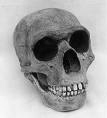 The technique, invented by evolutionary analysts in Argentina, marks a smash with the conservative technique by which anthropologists diagram entwines and rotates of the human odyssey. Those techniques characteristically split the type. Homos are classified into different classifications as per the shape of key facial features flat-faced, “protruding-faced” and so on. Integration these assorted classifications from a petite number of variety straddling millions time has show the way to lots of allege and counter-claims. In addition to much bewilderment in the common public about how we came to be here.
A mixture of class of Homo has been erect for the coronet of being direct ancestor and only to find themselves sacked by critics as botched branches of the Homo tree. Rolando Gonzalez at the Patagonian National Center at Puerto Madryn and Argentina saying that problem with conventional way is under growth, facial behavior does not come into view out of the blue but outcome from unremitting alter. The group goes reverse over the same eminent group of specimens, other than uses diverse approach to study it, center in particular on a set of basic yet enduring changes in skull form.
Chinese Terracotta Army Covered in Egg
Study of Chinese terracotta army, is a collection of 7,000 soldier and horse figures in the mausoleum of the country’s first emperor, was completely cover with beaten egg when it was constructed, according to German and Italian chemists who have analyzed samples from several of the figurines.
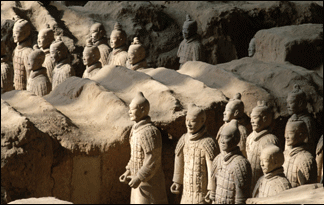 According to the research team, the egg served as a binder for colorful paints, which went over a layer of varnish.
Co-author Catharina Blaensdorf, is a scientist at the Technical University of Munich in Germay, explain to Discovery News that “egg paint is normally very stable, and not soluble in water…This makes less sensitive to humidity and moisture.”
Egg proteins would have also ensured the adhesion of the paint to the varnish, while also giving the paint thickness and texture, added Blaensdorf’s coworker Ilaria Bonaduce, of the University of Pisa in Italy.
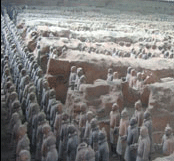 For the study, which has been accepted for publication in the Journal of Cultural Heritage, the researchers took samples from soldier figurine faces, kneeling archers, swans and paint fragments found on the ground inside the 210 B.C. mausoleum. They chemically separated the flakes to separate the ingredients, and then inserted them into a machine that determined their composition.
The researchers thought animal glue might have served as a binder, but all data pointed to egg instead. The pigments, they found, were bone white, lead white, cerussite (which sparkles), quartz, cinnabar, malachite, charcoal black, copper salts, Chinese purple & azurite.
Most Developing subject in India- Archaeology
Archaeology specialist from both overseas and those that are teaching in the country’s universities are now frazzled that archaeology was a extremely dedicated and developing subject whose innovations and findings had to be added by readings in other associated faculties.
They were discussing at an important seminar took place at K P Jayaswal Research Institute here on Saturday at Patna. The subject of the seminar was “Changing Perspectives and Methodologies in South Asian Archaeology”. The contributors in the initial session, presided over by Vidula Jayaswal, included Dilip K Chakrabarti from University of Cambridge with his paper on Indian archaeological findings, while K Paddayya from Deccan College Post Graduate and Research Institute (Pune) spoke for some noteworthy subjects of Indian archaeology.
Anglo-Saxon burial suggests pagan cult
British archaeologists have excavated a woman’s body adorned with jewelry and laid on a special bed in a site in Yorkshire. The woman’s body was buried in a grave at the center of an Anglo-Saxon cemetery.
Her jewelry includes a huge shield-shaped pendant, mounted by central blue gemstone; the pendant has scalloped-shaped carving with 11 separate lobes and a scalloped lower edge. Surrounding the central blue stone were small red gems latent in gold foil. Other artifacts that were two gemstone pendants, gold and glass beads, a hairpiece or jet pin. The burial bed was decorated with iron and consists of a wooden bed held together.
Both her jewelry and the placement of her grave suggest scientists that she should have been a member of the royal family who led the Pagan Cult. Archaeologist Stephen Sherlock believes that it is a cult because of the arrangement of graves, the short period of the cemetery’s use and the bed burial mound that is in the center of a regular cemetery.
The cemetery, named Street House, consists of 109 graves, most of which were dug in a square around the bed burial.”This square formation is unparalleled in Anglo-Saxon England,” Sherlock said.
Although the site’s acidic soil eroded the woman’s remains, the age of the cemetery and its location provide clues to her identity. Sherlock believes “likely suspects” include Ethelburga, the wife of King Edwin of Northumbria, who converted to Christianity and was made a saint. Other possibilities are Eanflaed, the wife of King Oswiu, or Oswiu’s daughter, Aelflaed.
Clay Tablet mystery deciphered
The mystery of clay tablet at the British Museum was deciphered by British scientists Today.
It was believed that a huge asteroid hit the Köfels in the Austrian Alps about 5000 years ago which was the cause of the puzzling land shape. There was no proof that the asteroid was the cause for the mysterious land shape at Köfels.
But now Alan Bond, the managing director of Reaction Engines, space propulsion company, and Mark Hempsell, the senior lecturer of astronautics at Bristol University have deciphered the cuneiform code. They used a computer program which traces back the night sky thousand of years ago to provide an explanation. They say that the symbols denote the trajectory of a large object travelling along the constellation of Pices is liable that it has hit Köfels within one degree distance. Their theory also mentions why a crater was not formed inspite of the huge impact.
According to Hempsell, the size and route of the asteroid meant that it was likely to have crashed into the Austrian Alps at Kofels. As it traveled close to the ground, it would have left a trail of destruction from supersonic shock waves and then slammed into the Earth with a cataclysmic impact.
Debris consisting of up to two thirds of the asteroid would have been hurled back along its route and a flash reaching temperatures of 400C (752F) would have been created, killing anyone in its path. About one million sq km (386,000 sq miles) would have been devastated and the impact would have been equivalent to more than 1,000 tonnes of TNT exploding.
“The ground heating, though very short, would be enough to ignite any flammable material, including human hair and clothes,” said Hempsell.
“It is probable more people died under the plume than in the Alps due to the impact blast,” he added.