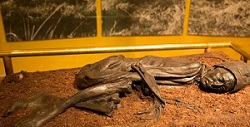
The Tollund man is a well-preserved Iron Age bog body that was discovered in 1950 in a small peat bog in Jutland, Denmark. The body is believed to have been placed in the bog between 375 and 210 BC, and is one of the most famous archaeological discoveries in the world. The body was found to be that of a man in his 40s who appears to have been a victim of ritual sacrifice. His clothing, tools, and other artifacts suggest that he was a member of an Iron Age farming community. The body has given archaeologists and historians a unique insight into the Iron Age, and it is currently on display at the Silkeborg Museum in Denmark.
He was found lying face down, with a leather belt around his waist, and a pointed leather cap on his head. His body was preserved in a state of remarkable preservation due to the anaerobic conditions of the peat bog in which it was found. The Tollund Man has been studied extensively by archaeologists and anthropologists, and has provided important insights into the lifestyle and culture of the Pre-Roman Iron Age.
The body of the Tollund Man has been used to reconstruct the lifestyle of the people who lived in the area at the time. Through analysis of the Tollund Man's clothing and possessions, archaeologists have been able to piece together what life must have been like for Iron Age people in Northern Europe. Analysis of the body has also allowed archaeologists to gain insight into Iron Age burial practices. It is believed that the Tollund Man was a human sacrifice, and this has provided an important piece of evidence for understanding the religious practices of Iron Age people.
The Tollund Man is an important archaeological find, and has played an important role in understanding the history and culture of Iron Age people in Northern Europe. Through analysis of the body, archaeologists have been able to gain insight into Iron Age burial practices, religious beliefs, and lifestyle. The Tollund Man is a remarkable example of prehistoric preservation, and is an important reminder of the past.
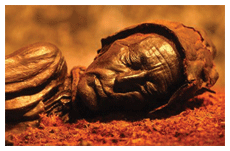
The Significance of Tollund Man in Prehistoric Archaeology :
- Tollund Man is the name given to a remarkably well-preserved Iron Age bog body that was discovered in 1950 in a peat bog near the village of Tollund, Denmark.
- The body, which dates to around 300 BCE, is considered to be one of the most significant archaeological discoveries of the 20th century.
- The discovery of Tollund Man provides archaeologists with a unique window into the life and death of Iron Age Europeans.
- The body, which was discovered with its skin intact and its facial features still visible, offers an unprecedented level of detail about Iron Age life and death.
- Analysis of the body's clothing and other artifacts suggest that the man was likely a sacrificial offering to the gods.
- In addition to providing a wealth of information about Iron Age life and death, the discovery of Tollund Man has also had a major impact on the field of archaeology.
- Prior to the discovery of Tollund Man, archaeologists had assumed that most Iron Age bodies had been destroyed by the acidic and anaerobic environment of peat bogs.
- The discovery of the well-preserved body proved that some Iron Age bodies could indeed survive in such an environment, leading to further research into bog bodies and a better understanding of Iron Age life and death.
- The discovery of Tollund Man has also had a major impact on the study of human sacrifice in Iron Age Europe.
- Prior to the discovery of Tollund Man, archaeologists had assumed that human sacrifice had been rare in Iron Age Europe.
- The discovery of the well-preserved body provided evidence that human sacrifice was a common practice in the region.
- This has led to further research into the practice of human sacrifice in Iron Age Europe, and helped to shed light on the religious and cultural beliefs of the people of the time.
- The discovery of Tollund Man is one of the most significant archaeological discoveries of the 20th century.
- The body provides an unprecedented level of detail about Iron Age life and death, and has had a major impact on the study of human sacrifice, bog bodies, and Iron Age burial practices.
- The discovery of Tollund Man is a testament to the importance of archaeology in uncovering the past, and the significance of this discovery will continue to be felt for many years to come.
Tollund Man: A Window into Ancient Scandinavian Culture
Tollund Man is an incredibly well-preserved prehistoric bog body discovered in 1950 near the village of Tollund, Denmark. This ancient corpse is thought to have lived during the 4th century BCE, and has since become an important archaeological find for shedding light on the beliefs and customs of the ancient Scandinavian culture.
The Tollund Man was found in a perfectly preserved state, his skin intact and his facial features still visible. His body was discovered alongside a pointed leather cap, a belt, and a noose, suggesting that he may have been a sacrificial victim of some kind. This has led to many theories about the Tollund Man and his death, with some experts believing that he may have been a victim of a ritualistic human sacrifice.
The Tollund Man's clothing and artifacts have also provided insight into the everyday life of the ancient Scandinavians. His leather cap, for example, is unique in that it is not found in any other archaeological sites of the same period. This suggests that the people of the time had their own distinct style of adorning their heads.
The belt that was found with the body indicates that the Tollund Man was a man of some standing in the community, as belts with decorations and symbols are usually reserved for the upper classes of Scandinavian society.
The Tollund Man has also provided a window into the religion of the ancient Scandinavians. The noose suggests that he may have been a victim of a ritualistic human sacrifice, and it is believed that this type of sacrifice was practiced by the pre-Christian religion of the ancient Scandinavians. This finding has helped to shed light on the spiritual and ritualistic practices of the time, and has helped to give us a better understanding of the beliefs and customs of the people of the ancient Scandinavian culture.
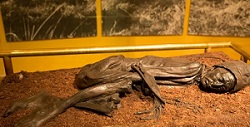
Examining the Environment in which Tollund Man was Buried :
- The Tollund Man is an archaeological site in Denmark, located near the settlement ofSilkeborg. He was discovered in 1950, and is believed to have been buried around 350 BC. His body was remarkably well-preserved, making him a unique archaeological find.
- The environment in which Tollund Man was buried is an important part of understanding his life and death. The area is part of a peat bog, which is a wetland made up of mostly decomposed vegetation. This type of environment helps preserve organic material, making it an ideal place for Tollund Man to be found.
- The climate in the area is cold and damp, with temperatures typically ranging from -4 degrees Celsius to 8 degrees Celsius. The area experiences a lot of rainfall, averaging around 750 millimeters each year. These conditions are ideal for the preservation of organic material, which is why Tollund Man remains so well-preserved.
- The soil in the area is predominantly peat, which is made up of partially decomposed organic material. The soil is also rich in nutrients, which help to preserve organic material. This nutrient-rich soil helps to explain why Tollund Man was so well-preserved when he was found.
- The vegetation in the area is mostly moss and grass, with some shrubs and small trees. This type of vegetation is typical of a peat bog environment, and is likely what helped to preserve Tollund Man's body.
- The area near where Tollund Man was found is low-lying, which would have made it prone to flooding. This could explain why Tollund Man was found in a pool of water, which helped to keep his body preserved.
- The environment in which Tollund Man was found is an important part of understanding his life and death. The cold and damp climate, nutrient-rich soil, and low-lying area all helped to preserve his body, making him a unique archaeological find.
The Impact of Tollund Man on Modern Interpretations of Prehistoric Life :
The Tollund Man is an archaeological find that has had a profound impact on modern interpretations of prehistoric life. He is a remarkably preserved Iron Age corpse discovered in 1950 in a peat bog in Denmark. The body is thought to be that of a man who lived and died sometime between 375-210 BC. The remarkable state of preservation of the Tollund Man was due to the acidic environment of the bog, which prevented the body from decomposing.
The Tollund Man has provided archaeologists with invaluable insights into the lifestyles of Iron Age people. Detailed analysis of his clothing, hair, and preserved facial features have shed light on the clothing styles, hairstyles, and facial features of Iron Age Europeans. In addition, his stomach contents revealed the diet of Iron Age Europeans, which included wheat and barley, as well as animal fat.
The discovery of the Tollund Man has also allowed archaeologists to gain a better understanding of Iron Age burial rituals. Analysis of his clothing and body position suggest that he was laid to rest in a ritualistic manner, which suggests that Iron Age people had a certain level of religiosity and reverence for their dead.
The Tollund Man has also provided archaeologists with insights into Iron Age medicine. His preserved brain revealed evidence of a trepanation, a hole made in the skull to release pressure on the brain. This suggests that Iron Age people had a rudimentary understanding of the human body and the treatment of injuries and infections.
The impact of the Tollund Man on modern interpretations of prehistoric life has been immense. His remarkable preservation has allowed archaeologists to gain a wealth of knowledge about Iron Age Europeans and their lifestyles, burial rituals, and medical practices. His discovery has revolutionized our understanding of prehistoric life and has allowed us to gain a more complete picture of how Iron Age people lived.
Also see other
archaeological discoveries
Important archaeological Discoveries
Amesbury ArcherAmesbury Archer (or King of Stonehenge) is an early Bronze Age man, dating to around 2300 BC. His grave is of particular importance because of the rich valuables and the earliest gold objects ever found in England.
Otzi the Ice mummyOtzi the Iceman is well naturally preserved mummy of a man. The man who was been captured in Ice was believed to be over 53 centuries old (3300 BC).
Java ManJava man is an interesting discovery to note that the find was not a complete specimen, but consisted merely of a skullcap, a femur, and three teeth. Many scientists of the day even suggested that Dubois' Java Man might have been the so-called "
missing link
Kennewick ManKennewick Man is the name for the remains of a prehistoric man found on a bank of the Columbia River near Kennewick, Washington, on July 28, 1996. The Kennewick Man news story is one of the most significant archaeology stories of contemporary times.
Neanderthal ManNeandertal1 or Neanderthal was a species of genus Homo (Homo neanderthalensis) that inhabited Europe and parts of western Asia during the last ice age.
Peking ManPeking Man (sometimes now called Beijing Man), also called Sinanthropus pekinensis (currently Homo erectus pekinensis), is an example of Homo erectus.
Red lady of PavilandThe Red Lady of Paviland is a fairly complete Upper Paleolithic-era human male skeleton dyed in red ochre, discovered in 1823 by Rev. William Buckland in one of the Paviland limestone caves of the Gower Peninsula in south Wales, dating from c29,000.
Tollund ManThe Tollund man lived during the late 5th century BC and/or early 4th century BC, about 2,400 years . He was buried in a peat bog on the Jutland Peninsula in Denmark, a find known as a bog body.
Turkana BoyTurkana Boy, the designation given to fossil KNM-WT (Kenya National Museum-West Turkana), is a nearly complete skeleton of a 12-year-old hominid boy who died 1.6 million years ago.Turkana Boy is classified as either Homo erectus or Homo ergaster.
Dead Sea scrollsThe Dead Sea Scrolls are a collection of about 850 documents, including texts from the Hebrew Bible, which were discovered in eleven caves near Qumran, in a fortress northwest of the Dead Sea in Israel.
Narmer PaletteThe Narmer Palette, or Great Hierakonpolis Palette, is a significant Egyptian archeological find, dating from about 3200 BC, containing some of the earliest hieroglyphic inscriptions ever found, and depicting the unification of Upper and Lower Egypt under Narmer.
Rosetta StoneRosetta Stone is a dark granite stone (often incorrectly identified as "basalt") which provided modern researchers with translations of ancient text in Egyptian demotic script, Greek, and Egyptian hieroglyphics.
Linear BLinear B is the script that was used for writing Mycenaean, an early form of the Greek language. It occurrs primarily on tablets dated from the 14th and 13th centuries BC.
Sweet trackThe Sweet Track is an ancient roadway in the Somerset Levels, England. As of the early 2000s, it is the oldest known engineered roadway in the world. An grand footpath that ran for almost 2km across the Somerset levels swamps.
Tautavel ManTautavel Man is an ancestor of Neanderthal man, was slightly different from his contemporaries living Asia and Africa. In the village of Tautavel is located in the South of France, one of the most ancient humans was found: the Tautavel Man.
Galilee BoatThe
Galilee Boat which is also referred as the "Jesus Boat" was found by local
Galilean inhabitants in January 1986. The boat was wrapped in a polyurethane shell and then immersed in a special tank of water to avoid quick disintegration.
Ekron InscriptionThe monumental
Ekron inscription is dated, statistically and historically, to the first half of the seventh century B.C.E. The five lines of the inscription are together with this in a slit open border.
Pontius PilateIt wasn't long back when a lot of scholars were quizzical the real survival of a Roman Governor with the name Pontius Pilate, the procurator who ordered
Jesus' crucifixion. In June 1961 close to Caesarea-on-the-Sea (Maritima) was unearthed this appealing limestone block.
Ossuary of CaiaphasIn 1990 ornately decorate limestone ossuary (bone depository) was found in Jerusalem's Peace Forest. In the ossuary were the bones of two babies, a adolescent child, a teenage boy, an adult woman, and a man about 60years of age.
Baruch BullaIn
biblical Israel, papyrus was the main form of writing substance. Once an authorized deed was written, it would be rolled up, one end crinkled in one-third of the width and the contrary end likewise folded in.
Ugarit-Pre historic cityIt is the Capital city of a prehistoric principality in what these days is on the northern part of the Syrian coast, just north of the city of Latakia.