Narmer Palette
The
Narmer Palette, is an ancient Egyptian ceremonial and commemorative piece of art. It was carved from a single block of siltstone and is estimated to have been created around 3100 BC. The palette is decorated with intricate carvings and hieroglyphs that tell the story of King Narmer, the first pharaoh of the first dynasty.
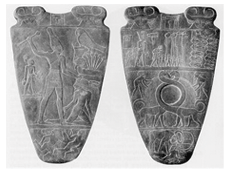
The palette is divided into two registers, each of which contains a scene of the king and his entourage. On the first register, Narmer is shown wearing the crown of Upper Egypt and holding a mace in his right hand, while the second register depicts the king wearing the crown of Lower Egypt and holding a scimitar in his left hand.
One of the most notable elements of the palette is the depiction of a falcon-headed god, Horus, which is believed to represent the unification of Upper and Lower Egypt under Narmer's rule. The palette is believed to have been used in a ritual honoring Narmer's victory at the Battle of Memphis, where he unified the two regions. The Narmer Palette is now housed in the Egyptian Museum in a'Cairo, Egypt.
The Narmer Palette is a ceremonial palette that dates to approximately 3150 BCE and is believed to depict the unification of Upper and Lower Egypt by the first Pharaoh of the First Dynasty, Narmer. The Palette is one of the most important artifacts from the Early Dynastic period in ancient Egypt, and is believed to be the first monument to document the unification of the two kingdoms.
The Palette is made of siltstone and is divided into two parts. The top part of the Palette shows a figure wearing the White Crown of Upper Egypt, whose name is believed to be Narmer. He is shown in a pose of victory and is holding a mace and the "flail of kingship". On the bottom part of the Palette, Narmer is shown wearing the Red Crown of Lower Egypt, and is engaged in a battle with a foreign enemy. This is believed to represent the unification of the two kingdoms.
The importance of the Narmer Palette lies in its symbolism. It is believed to be the first example of a record of a ruler's accomplishments, and it marks the beginning of a long tradition of royal commemoration. The Palette also serves as a reminder of the importance of kingship in ancient Egypt, and it is a symbol of the strength and power of Narmer and the Pharaohs who followed him. Finally, the Palette serves as an important reminder of the rich history of ancient Egypt and the events which shaped its civilization.
Archaeological Discoveries of the Narmer Palette :
- The Narmer Palette is an ancient Egyptian piece of art that was discovered in 1898 in the temple of Horus at Hierakonpolis, Egypt.
- It is a ceremonial palette that was used in the coronation of Pharaoh Narmer, who is believed to be the first pharaoh of Egypt. The palette is made of schist and is in the form of a shield, with a handle on one side.
- It is decorated with an intricately carved scene showing Narmer wearing the crown of Upper and Lower Egypt and smiting his enemies.
- The Narmer Palette is an important artifact for several reasons. First, it is the oldest known example of a unified Egypt, with Narmer wearing the double crown of Upper and Lower Egypt.
- This indicates that Egypt was unified at this time, and it shows a level of sophistication in art and writing that was not seen before.
- The Narmer Palette is the first known example of hieroglyphic writing in Egypt. It contains two lines of hieroglyphic text, which are believed to be the earliest known example of this form of writing.
- The Narmer Palette also shows a level of sophistication in art and craftsmanship that was not seen before. It is intricately carved with a great level of detail and precision, which indicates a high level of skill among the artisans of the time.
- The Narmer Palette is an important piece of evidence in understanding the history of Egypt.
- It is believed to have been created around 3100 BCE, which means that it provides us with valuable insight into the political, religious, and social structures of Ancient Egypt. It also shows us the importance of art and writing in the culture of Ancient Egypt.
Representation of Ancient Egyptian Kingship in the Narmer Palette :
- The Narmer Palette is an ancient Egyptian artifact that was used to present the concept ofkingship at the time of its creation.
- The palette is believed to have been created during the reign of the pharaoh Narmer, who unified Egypt around 3000 BC. The palette is divided into two sides, with each side representing a different aspect of kingship.
- The front side of the palette is divided into four registers, with each register depicting a scene related to the concept of kingship. The top register has a pair of deities, who are believed to represent Upper and Lower Egypt.
- This is meant to show that the divine power of the king is over both regions. The second register features a pair of human figures, likely representing Narmer and his enemies.
- The third register depicts Narmer wearing the white crown of Upper Egypt and holding a mace and a staff, which symbolize his power and authority.The bottom register shows the king trampling his enemies, demonstrating his power and supremacy.
- The back side of the palette is divided into three registers, with the top register showing Narmer wearing the red crown of Lower Egypt and holding a mace and a staff. This is meant to symbolize the unity of the two regions and the king's power over them.
- The second register features a bull with a human face, which is believed to represent Narmer as the divine ruler of Egypt. The bottom register shows a scene of a goddess offering the king a gift of a staff and a mace, which symbolize his power and authority.
- The Narmer Palette is a powerful representation of ancient Egyptian kingship. It demonstrates the power of the king, his divine authority, and the unity of Upper and Lower Egypt. It also serves as a reminder to future generations of the importance of a unified Egypt, with a powerful ruler at its helm.