Experimental Archaeology
GreatArchaeology» Experimental archaeology
Experimental archaeology is the attempt to recreate or use ancient structures or artefacts in order to learn more about ancient technology based on (primarily) archaeological source material. This can provide important information for archaeologists and can be a good way to test a hypothesis or an interpretation.
It should not be confused with historical reenactment, which is generally undertaken for entertainment, rather than to examine ancient technology.
Experimental archaeology
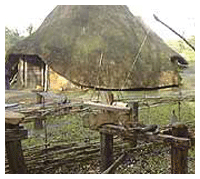
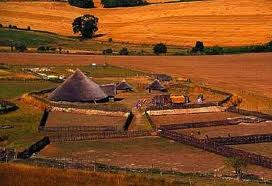
One of the main forms of experimental archaeology is the creation of copies of historical structures using only historically accurate technologies. This is sometimes known as reconstruction archaeology. A good example is Butser Ancient Farm in the English county of Hampshire which is a working replica of an Iron Age farmstead where long-term experiments in prehistoric agriculture, animal husbandry and manufacturing are held to test ideas posited by archaeologists.
In Denmark, the Lejre prehistoric farm carries out even more ambitious work on such diverse topics as artificial Bronze Age and Iron Age burials, prehistoric science and stone tool manufacture in the absence of flint.
Experimental archaeology is one of the very practical methods of archaeological interpretation. It is a living analytical process used to re-create aspects in part or in whole, of ancient societies in order to test hypotheses or proposed interpretations and assumptions about that society.
Experimental archaeology Contains Following Chapter:
Experimental archaeology attempts to observe a modern manufactured replica of an ancient site and/or objects based on the discoveries of items from the archaeological record, in a controlled environment where archaeologists can test and re-test their theories about the lost society.
Very often there are only a few artefacts discovered at an archaeological site. There may also be remnants of buildings and other structures but as a whole collection the absence of a full complement of items limits understanding of the site and therefore the archaeologist is required to 'guess' the missing pieces.
By 'missing pieces' we mean, for example, that at Stonehenge megaliths have been moved from their source and placed in an upright position. There has been no mechanical type tools ever discovered that would clearly indicate how the stones were transported or how they were fixed in upright positions. Without the hard archaeological evidence archaeologists can only guess at how it was done. In scientific circles such a guess is called an hypothesis.
Archaeologists attempt to recreate the exact ancient conditions using only the same known materials available to the ancient culture. This method of experimental archaeology uses a variety of techniques, methods, and approaches to test the theories but all methods have the one goal: to advance an idea and to test its validity.
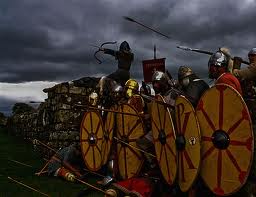
Experimental archaeology has two distinct variants. The first is called historical re-enactment and it is an artificial re-creation of a past culture (or part of it) and the testing of all of the many theories about building construction, transport systems, weapons, metals, ceramics, use of fire and so on.
The second variant is known as living history, and it requires archaeologists, usually coupled with anthropologists, to find a similar modern group of people living in and under the same types of conditions of the ancient target group, and to live with, or at the very least, to observe and study that group in order to determine the hows, whats and whys that are unstated in the archaeological record.
Historical re-enactment is the most common form of experimental archaeology and by far the most profitable for researchers as tests can be repeated and small adjustments made in a suitably controlled manner to yield scientifically valid results.
For this reason historical re-enactment has branched forth to include many enactment themes. Reconstruction archaeology is one area that has benefited from experimental archaeology. Here, the archaeologist creates copies of historical buildings, tools, or other objects, using only historically accurate materials and technologies.
Many fine replicas of artefacts are made and displayed in museums throughout the world. However, most of these are manufactured using modern machines and are often not even made of the original raw materials. The specialist in reconstruction archaeology will deliberately be limited to the use of only known raw materials and only processes and technologies known to have existed at the target time in history.
Through these limitations archaeologists are able to test their own theories about how tools were made, how buildings were constructed, how strong a tool is, and consequently answer the many unknown questions relating to these items.
There is a fully functioning replica of an historic Iron Age farm in the English county of Hampshire. Although the recreated farm would make a unique tourist attraction the product of the historical re-enactment is archaeological data and not simply to display a realistic replica of an old farmstead. The working farm hosts many long-term experiments and tests ideas about agriculture and animal domestication.
In an offshoot of reconstruction archaeology there are some experts who specialise in constructing ancient buildings using only the exact tools, methods, and materials that their former builder used in ancient time. These are historically accurate reproductions in every way and are particularly expensive and time consuming to do.
Experimental archaeology is a systematic and controlled method of interpretation of artefacts discovered in the archaeological record. By testing the validity of archaeological assumptions, archaeologists are expanding the database of empirical knowledge about ancient humanity.
Books on the Computational archaeology :
Experimental Research in Archaeology - Jeffrey R. Ferguson,University Press of Colorado, 2010
Designing Experimental Research in Archaeology is a guide for the design of archaeological experiments for both students and scholars. Experimental archaeology provides a unique opportunity to corroborate conclusions with multiple trials of repeatable experiments and can provide data otherwise unavailable to archaeologists without damaging sites, remains, or artifacts.
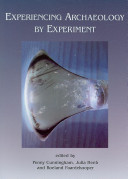
Experiencing archaeology by experiment: - Penny Cunningham, Julia Heeb, Roeland Paardekooper,Oxbow Book, 2008.
There is a growing trend among archaeologists to re-create artefacts and actions at a 1:1 scale in order to answer questions and gain new insights into the past. In November 2007, the University of Exeter hosted a one-day conference on experimental archaeology, and it was soon discovered that experience is a key issue in understanding the use of materials and past processes.
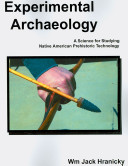
Experimental Archaeology - Wm Jack Hranicky, William Jack Hranicky,Authorhouse, 2006.
Experimental Archaeology: A Science for Studying Native American Prehistoric Technology
Rich Resources over the web on Computational archaeology
- ArchaeologyExpert :
ArchaeologyExpert is a practical resource that conveniently catalogues a wealth of pertinent articles in relevant sections, suitable for either the professional or the enthusiastic amateur.
- Experimental Archaeology: : The field of experimental archaeology can generally be divided into four categories: controlled replication of recovered artifacts or known activities; testing the validity of methodological assumptions by applying them to known data or results; "contextual"; and ethnographic data. Experimental archaeology can also be described by using these questions: What was ancient man doing? Why? How? These questions can be answered in many different ways.